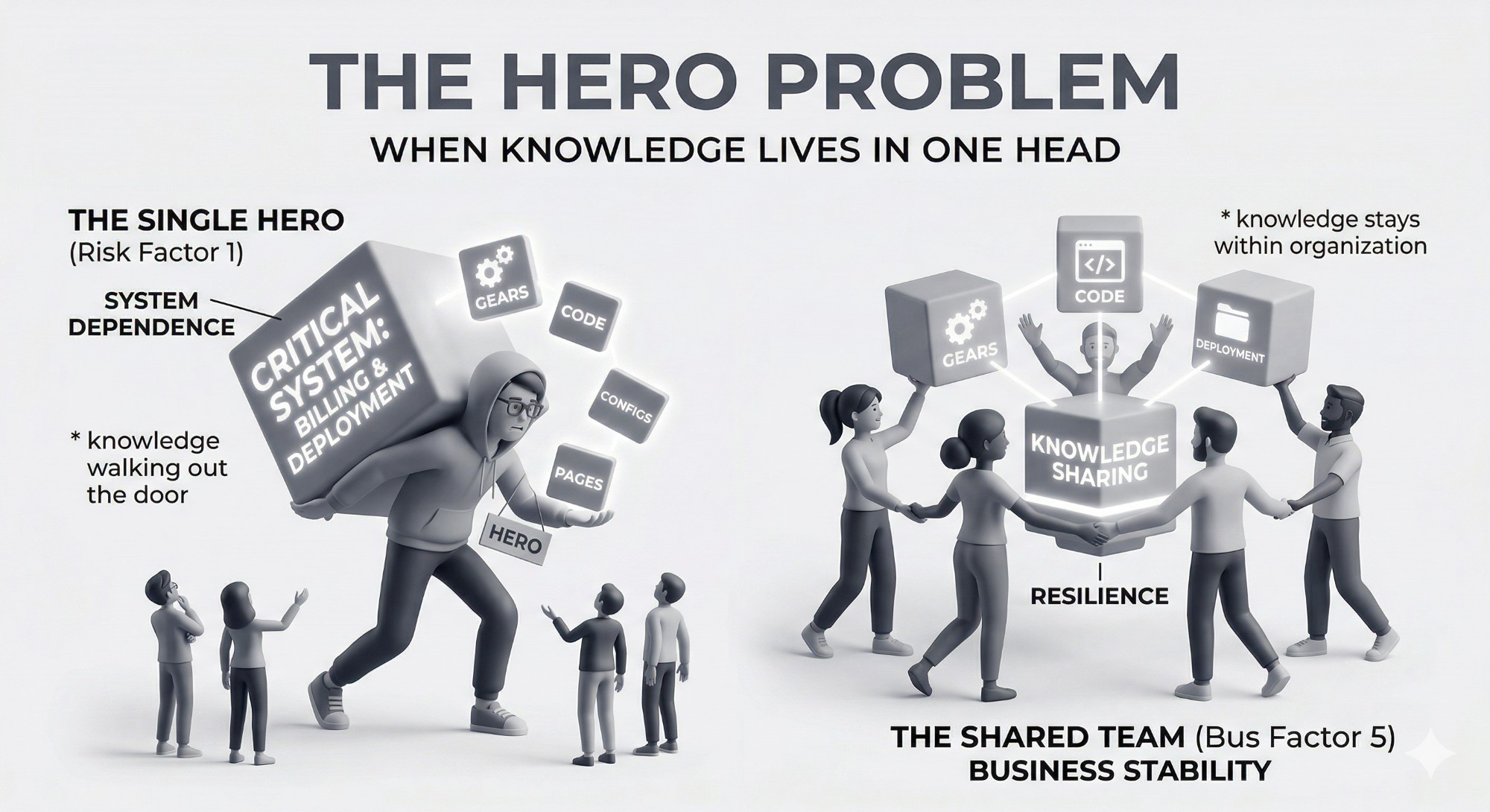
Every engineering organization has heroes. The people who built the critical systems. The ones everyone asks when something breaks. Here's why that's your biggest risk.
Heroes emerge naturally. Someone builds the billing system. They know every edge case, every workaround, every reason that weird config file exists. Over time, they become the only person who can deploy it, debug it, or explain why it works the way it does.
This isn't a failure of management. It's the default outcome of how software gets built. People specialize. Knowledge concentrates. And one day you realize that your most critical business system is maintained by exactly one person.
The cost isn't when they're there
Heroes are productive. They ship fast because they carry the full context in their heads. They fix things quickly because they've seen every failure mode. From the outside, they look like your best investment.
The cost hits when they leave. Or go on vacation. Or get sick. Or just burn out from being the only person who can answer the 2 AM page.
We've seen this pattern dozens of times. A senior engineer departs. Within weeks, the team discovers that entire subsystems are effectively unmaintainable. Not because the code is bad. Because the knowledge required to operate it walked out the door.
Bus factor is a business metric
The term sounds morbid. It's also precise. Bus factor: the number of people who would need to be hit by a bus before a project becomes unmaintainable. If the answer is one, that's not a technical problem. That's a material business risk.
And it's more common than most leaders realize. In our assessments, we regularly find critical systems where a single engineer accounts for 80% or more of all commits. Not because nobody else is capable. Because nobody else has the context.
How we measure it
Git history doesn't lie. We analyze commit patterns, code ownership, and change frequency to map exactly where knowledge concentration exists. Which modules have a single point of knowledge. Which systems haven't been touched by more than one person in over a year. Which files are changed frequently but understood by few.
The output isn't a vague risk rating. It's a map. Here's where you're exposed. Here's what breaks if this person leaves. Here's what it would cost to rebuild that knowledge.
Documentation isn't the fix
The instinctive response: make them write it down. Create a wiki. Document the architecture. Build runbooks.
It doesn't work. Not because documentation is bad, but because it decays the moment it's written. Systems change. Docs don't. Within six months, the wiki describes a system that no longer exists. Engineers learn to ignore it.
The real fix is structural. Cross-training. Pair programming on critical systems. Rotating on-call responsibilities so more than one person understands the failure modes. Code review practices that spread knowledge rather than gatekeep it.
But none of that works if you don't know where the concentration exists in the first place. You can't fix what you can't see.
The $200K lesson
Here's a pattern we've seen more than once. A company loses a senior engineer. Maybe they go to a competitor. Maybe they just burn out. The departure is amicable. Everyone wishes them well.
Then the team tries to modify the system that person built. They discover there's no documentation. The architecture is non-obvious. The deployment process involves three manual steps that nobody else knows about. Edge cases are handled by code that looks wrong but is actually correct for reasons that aren't written down anywhere.
Six months later, the team has spent the equivalent of $200K+ in engineering time just rebuilding knowledge that was never shared. Not building new features. Not reducing debt. Just getting back to a baseline understanding of their own system.
That's the real cost of knowledge concentration. Not the hero's salary. The recovery when they're gone.
What boards should ask
Most boards never ask about knowledge concentration. It doesn't show up in sprint velocity or uptime metrics. It's invisible until it's not.
One question changes the conversation: "If our top 3 engineers left tomorrow, what breaks?"
If the CTO can answer with specifics, that's a sign of a healthy organization. They know where the risk is and they're managing it. If the answer is vague reassurance, that's a finding.
The goal isn't to eliminate heroes. It's to make sure their knowledge doesn't leave when they do. That requires knowing where the concentration exists, measuring it over time, and building systems that distribute knowledge rather than hoard it.
"The question isn't whether you have heroes. Every organization does. The question is whether you know what happens when they leave."
We help leadership teams answer that question with evidence, not opinions. Git history analysis. Knowledge concentration mapping. Risk mapped to business impact, not adjectives. Because by the time you feel the pain of knowledge concentration, the hero is already gone.