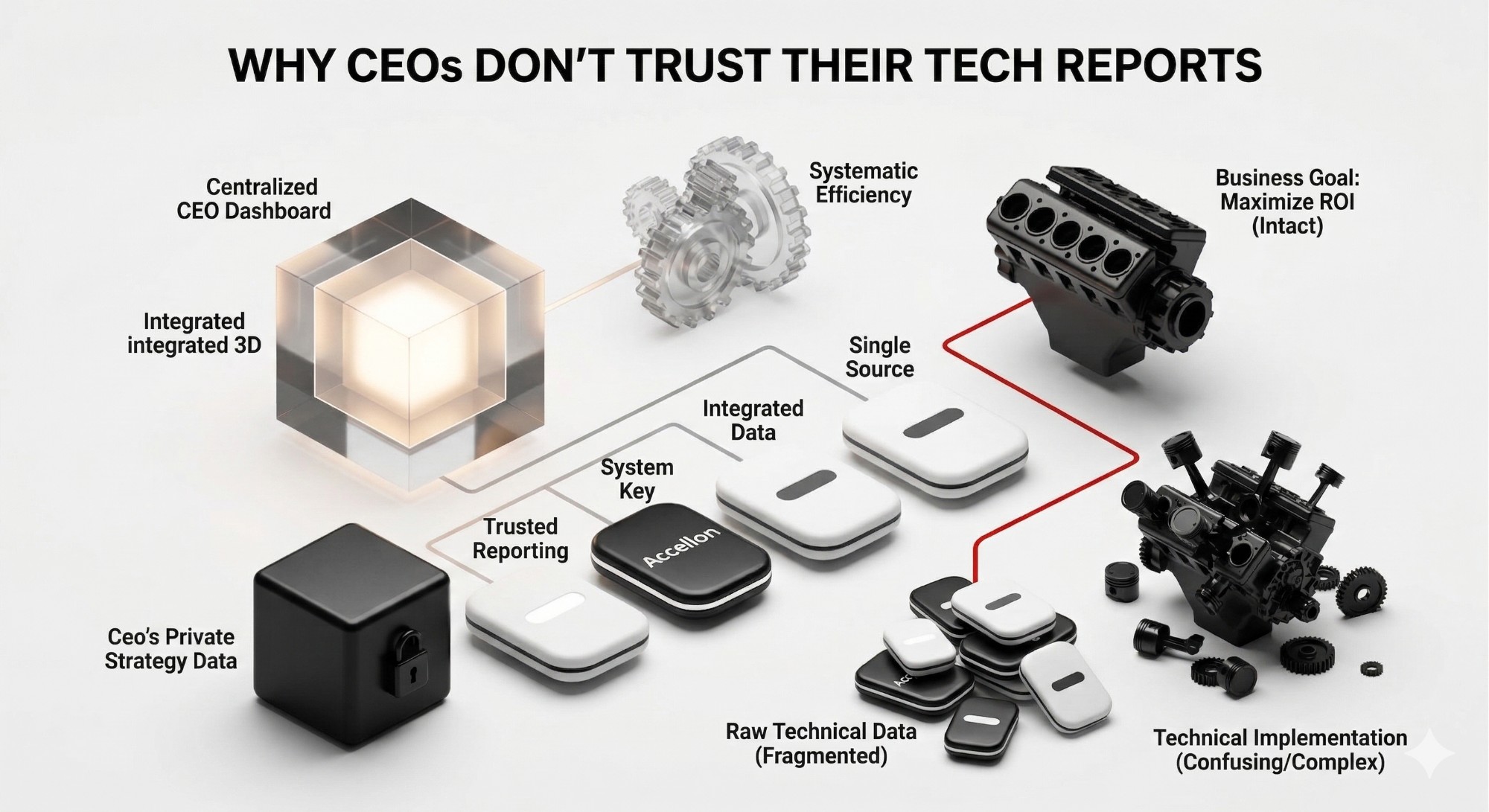
You ask "how's the tech?" and get reassurance or headcount requests. Neither tells you what you need to know. Here's why the trust gap exists and what to do about it.
Here's a scene that plays out in companies every week. The CEO asks the CTO for an update on the technology. The CTO gives a confident summary. Projects are on track. The team is performing well. A few challenges, but nothing major. Everything under control.
Six months later, something breaks that was never on anyone's radar. A critical system fails. A key engineer leaves and takes irreplaceable knowledge with them. An integration that was "almost done" turns out to need six more months. A security issue surfaces that nobody mentioned.
The CEO isn't angry about the problem. They're angry about the surprise.
Why it happens
It's not that the CTO is lying. Almost never. The CTO is reporting what they see. And what they see is progress. Features shipping. Sprints completing. The backlog shrinking.
But engineering teams report on what they're building. Not what they're afraid of. Progress is visible — it shows up in demos, releases, metrics dashboards. Risk is invisible. It lives in the code nobody looks at, the documentation that doesn't exist, the engineer who hasn't taken a vacation in two years because the system falls apart when they're gone.
The CTO reports the visible. The invisible stays invisible. Until it doesn't.
The trust gap
This creates something we call the trust gap. The CEO has a version of reality based on the reports they receive. The codebase contains a different version. And nobody is deliberately creating the gap — it's structural.
The CTO sees the system from the inside. They know the decisions they made, the tradeoffs they chose, the risks they're managing. From their perspective, everything is under control because they're controlling it.
But the CEO doesn't see the tradeoffs. They see the outputs. And when the outputs are "on track" but the underlying system is fragile, the CEO has no way to know until the fragility becomes a failure.
The visibility problem
A CFO has audited financials. Independently verified. A CEO has board-ready P&L statements backed by accounting standards and external review.
But technology? The CEO gets roadmap slides and velocity charts. No independent verification. No standard framework. No audit. The CEO is making decisions about a critical business asset based entirely on self-reported data from the team that manages it.
In every other domain, we'd call that a governance gap.
What CEOs actually need
Not more reports. Not more dashboards. Not more meetings with engineering. CEOs need the same clarity about technology that they have about finances. Evidence, not opinions.
Specifically, they need answers to questions that can't be answered with "everything's fine":
- What would it cost to rebuild? Not because you're going to rebuild. But because the gap between replacement cost and current investment reveals the real state of the asset.
- Who are the knowledge keepers? Which individuals hold critical knowledge that isn't documented or shared? What's the exposure if any of them leave?
- What percentage of time goes to maintenance vs. new features? If engineering is spending 70% of their time keeping the lights on, that's not a technology update. That's a strategic constraint.
- Where is compliance exposure? Not "are we compliant?" but "where specifically are the gaps, and what's the cost and timeline to close them?"
These questions require evidence from the codebase, not opinions from a meeting. They require looking at commit history, contribution patterns, dependency analysis, and architecture documentation — or the absence of it.
The financial analogy
Consider how companies handle financial oversight. Nobody thinks the CFO is incompetent because the company has external auditors. The audit isn't a sign of distrust. It's a governance mechanism. It gives the board confidence that the numbers are real.
Technology needs the same thing. An independent view. Not because the CTO can't be trusted, but because no single person — no matter how competent — can see their own blind spots. The CTO is too close to the system. They built it. They live in it. They're optimized for making it work, not for seeing what an outsider would see.
"You wouldn't rely solely on your CFO's word for the state of the finances. Why would you rely solely on engineering's self-assessment of the technology?"
The questions that close the gap
The fix isn't distrust. It's not bringing in consultants to second-guess the CTO. It's creating the same kind of independent visibility that exists for every other critical business function.
Start with evidence
Every codebase tells a story. Commit history shows who works on what. Churn analysis shows where complexity concentrates. Dependency maps show what's fragile. Contribution patterns show where knowledge lives. None of this requires anyone's opinion. It's all in the data.
Make it regular
A one-time assessment is a snapshot. Useful, but limited. The real value comes from regular independent review — the same way financial audits happen annually, not once. Trends matter more than data points.
Use business language
The output can't be a technical report. It has to be in the language the CEO uses to make decisions. Cost. Risk. Timeline. Options. A finding like "high cyclomatic complexity in the billing module" means nothing to a CEO. A finding like "the billing module costs 4 engineering weeks per quarter to maintain and one person understands it" changes decisions.
What good looks like
A CEO who has technology visibility doesn't micromanage engineering. They do the opposite. They trust more, because they can verify. They ask better questions. They make better decisions about investment, risk, and timing.
The CTO benefits too. Instead of defending a narrative, they have an independent source confirming what they already know — or surfacing risks they genuinely missed. It takes the politics out of the technology conversation and replaces it with evidence.
The fix isn't distrust. It's visibility. Give leaders the tools to see what's actually happening, and the trust takes care of itself.